
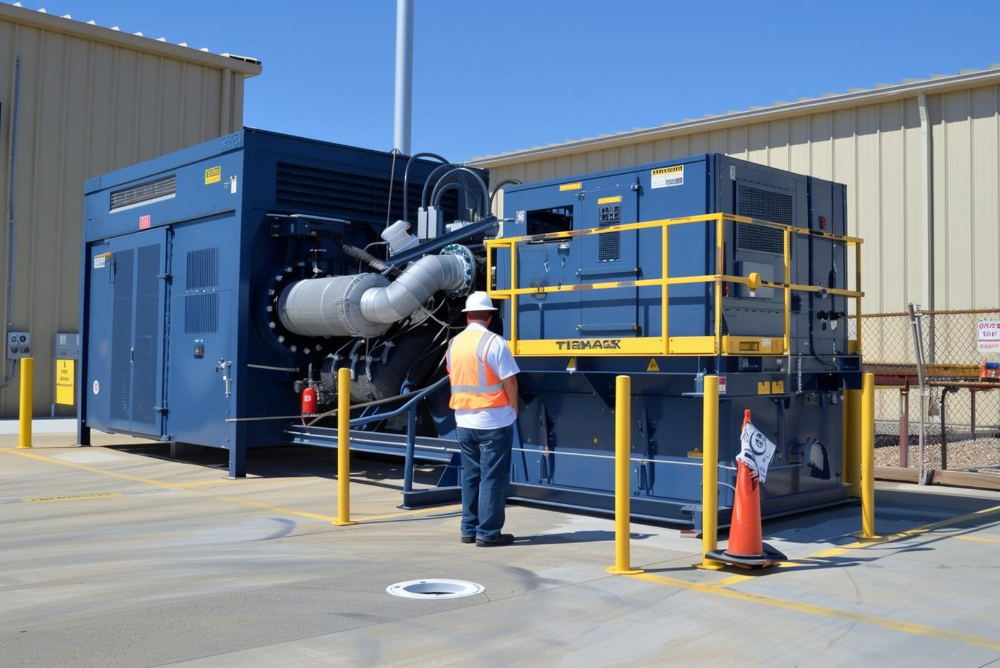
Calculating Generator Capacity in Industrial Settings
Sizing a generator for an industrialfacility can be complicated and bears little resemblance to picking the largest generator to cover the total wattage of the loads in the facility. A facility’s electrical load can include large electric motors, pumps, compressors, and many other rotating equipment. These loads, along with the equipment they are linked with, can vary from continuous operation to infrequent operation. For instance, a generator may need to supply power for the continuous operation of equipment along with the starting power for the infrequently operated equipment. Caterpillar states that generator size must account for the continuous operation of a facility as well as the starting power for equipment like motors and HVAC systems.
Generators can be thought of as the heart of an industrial electrical system. Like the heart of a living system, a generator must be able to safely meet the continuously varying electrical demand of the system. A generator may be able to provide the average or normal electrical demand of a facility, but still be unable to maintain safe electrical conditions for the facility. In equipment and systems design, there are many variables that must be considered when determining the electrical demand and the capacity of a generator, and these must be integrated to accurately size a generator. In critical systems, it is beneficial to consult an engineer or employ a generator manufacturer’s sizing program to integrate many of these variables.
Incorrect Generator Sizing
Sizing of the generator affects the reliability and performance of the equipment, fuel consumption, the life of the generator and how quickly the generator can respond to changes in demand. Generators, typically, are oversized, to meet the expected peak demand, or are of the correct size, to meet the normal demand of the facility. The expectation is that the generators always run within their limits and don’t see transient overloads, or experience more severe load changes, such as motor starting.
Caterpillar states that the peak demand, expected future expansion and surrounding conditions all impact the determination of the size of the generator. One must assume that, for Caterpillar, meeting the expected demand requires the generator be of the correct size.
Oversizing the generator can increase the cost of ownership and reduce the efficiency of the generator. The guidance provided by Caterpillar states that very light loading of a generator should be avoided. As with oversizing, one can assume that Caterpillar states that a very large generator is not always the best solution. The expectation is that, during normal operation, the generator be large enough to comfortably handle the demand of the facility and still remain within acceptable limits of frequency and voltage. It is important that the generator be large enough to handle the largest demand the facility can have, even if it is transient in nature.
Generator Capacity Should Be Higher Than Running Load
An industrial plant was used to illustrate an example where a combination of equipment has a normal operating demand of 400 kW. In this case, an engineer may conclude that a 400 kW generator should be sufficient. However, the example provided demonstrates that various factors should be considered when analyzing equipment demand and the size of a generator needed.
The example illustrates that equipment may include an induction motor. The demand for the normal operation of the motor may be less than the starting demand. A generator must have the capacity to provide the starting demand of an electric motor. Caterpillar states that the current required to start an electric motor may be 4 to 6 times greater than the current required for the normal operation of the motor.
An equipment demand analysis, which is similar to the example provided, is relevant for compressors, pumps, fans and large machines. The analysis should take into account the method used to start the equipment, the electrical load on the motor and other equipment that is connected to the generator. Ultimately, the demand for starting equipment connected to a generator should be considered in the analysis to determine the equipment size that should be purchased.
1. Develop a Complete Load List
To generate an industrial load schedule, a detailed list of all equipment expected to be powered by the generator during an outage must first be developed.
This equipment may include, but not be limited to:
- Production equipment
- Pumps and compressors
- Process and temperature control systems
- Ventilation equipment
- Lighting
- Control equipment
- Fire protection equipment
- Elevators
- Process and equipment power and control equipment
- Process and test instruments
- Process and auxiliary systems
Not all equipment powered by the generator is operated simultaneously, and it may be necessary to determine the equipment that may be operated during generator operation.
Important characteristics of each piece of equipment may include, but not be limited to:
- Voltage
- Phase
- Power and/or speed
- Current
- Starting method
- Whether the equipment is a motor load
- Whether the load is resistive or inductive
This information may be provided by the user or determined through testing. Load characteristics may also be defined as a function of other loads, and system limits may be established to reflect equipment operation and loading.
Caterpillar's load sizing tools provide similar features by requiring the user to define characteristics of the equipment and/or loads to be supplied.
A load table may be developed to contain:
| Load Table Information |
|---|
| Equipment name and/or identification |
| Number |
| Power |
| Operating power, if different |
| Power factor |
| Starting method |
| Starting order |
The load table may be used to determine the impact of individual equipment on the capacity of a generator. The table may also serve as a records document of changes made to process equipment during the operation of a facility.
Step 2
Separate Running and Starting Loads
After listing the loads, the next step is to identify the starting loads and the running loads. The running load of a piece of equipment is the electrical load required to operate the equipment. The starting load is the electrical load required to get the equipment to the operating condition.
For equipment consisting of resistive loads, the difference between the starting load and running load is negligible. For equipment containing induction loads, the starting load is much greater than the running load.
Multiple motor loads in an electrical facility can increase the starting load. This is typically the case for equipment containing an electric motor, such as pumps or fans. Cummins and Cat state that the starting current for large motors can be many times the normal running load.
For motors or other loads that can create a high inrush condition, it is important to consider the source of the equipment and how the equipment is controlled. It is also important to understand if there are other loads that will be operating at the same time.
The nameplate on the equipment gives information on the operating characteristics of the equipment. This includes the voltage and normal running load. The information provided by the equipment supplier may give the load and equipment characteristics and how the equipment is controlled.
Part-winding starter motors and variable frequency drives (VFDs) absorb some (but not all) electrical stresses generated during motor starting. Caterpillar notes variable frequency drives or other forms of reduced voltage starting should be considered if appropriate. As stated above, how the starting demand of a motor is controlled should be considered as part of the overall generator sizing process.
Step 3
Determine Running kW
When making a load determination the running kW for each item should be estimated. Nameplate ratings often are used to develop load estimates. Nameplate ratings often overstate the demand. A demand analysis should be performed to evaluate the actual demand.
A number of factors can contribute to nameplate ratings of equipment being greater than the actual demand, including equipment operating at partial load and equipment operating at suboptimal conditions. A detailed analysis of the facility demand can be useful in developing an estimate of generator set size.
A facility may have 150 kW of production equipment, 100 kW of pumps, 80 kW of HVAC, 40 kW of lighting and 30 kW of control and miscellaneous equipment. What is the minimum demand on the system?
| Equipment | Running Load |
|---|---|
| Production Equipment | 150 kW |
| Pumps | 100 kW |
| HVAC | 80 kW |
| Lighting | 40 kW |
| Control and Miscellaneous Equipment | 30 kW |
| Total Demand | 400 kW |
The minimum demand is the sum of the individual equipment loads. Therefore:
Demand = 150 + 100 + 80 + 40 + 30 = 400 kW
What has to be determined next is if the generator will also be able to meet this demand. The next question is what are the largest starting demands?
Step 4
Determine Starting kVA
Sizing a standby generator for your facility includes determining the starting kVA of the largest motor your system includes. A generator may not be able to start and, thus, may not be able to run a large motor if it does not have sufficient starting kVA, even if it is large enough to handle the running requirement of the motor.
There are several ways to determine starting requirements including:
- Reviewing motor nameplate data
- Utilizing generator sizing software
- Contacting the motor manufacturer
- Contacting the generator manufacturer
Generac has stated that determining the kVA to start and speed up a motor is essential in sizing a standby generator. Caterpillar also mentioned the importance of a generator set’s ability to start a motor in its literature covering the selection of generator sets.
Let’s say the largest motor at the facility has a normal service factor of 75 kW. What if the starting service factor of that same motor is 125 kW?
The 125 kW is not a value that the generator can afford to provide to the motor for an extended period of time. The generator must be able to provide that starting service factor for only a short time for the motor to accelerate to its normal service factor. The actual calculation will use the motor’s starting service factor and time, not an arbitrary factor.
Why Motor Starting Changes Generator Size
The primary factor determining the size of a generator is the peak load it must handle. However, motor starting can also dramatically alter the answer because starting a large motor can result in a momentary higher demand than the sum of the demand of all the small motors running at that time.
Hence, the size of a generator is typically determined by the larger of the two demands:
- The demand corresponding to the peak load
- The demand during the starting of a large motor
Generac has an example showing that starting a group of smaller motors in the correct order reduces the size of the generator required compared to starting the smaller motors in a larger group, or all at once, and showing that generator capacity can be significantly reduced, even if the equipment operated is the same.
Step 5
Load Sequencing
Once the generator starts, the loads are connected in a particular order, called load sequencing. Often, hundreds or thousands of loads are controlled by an automatic transfer or control system. If those systems can be designed to connect loads in a controlled manner, operation can be smoother and the largest demand limited.
Loads are connected in a variety of ways, based on the operation of the facility. Often, controls are connected first, followed by ventilation and/or pumping systems. Loads that cause large, unwanted variations in system voltage, such as large electric motor loads, may be connected last.
- Controls may be connected first.
- Ventilation and/or pumping systems may be connected next.
- Large electric motor loads may be connected last.
Large loads can be subdivided into smaller loads, if practical. Each load step should be planned to ensure control of system voltage. Considering load steps makes determination of the highest demand more precise. Rather than just determining the largest load, which is often the case, consideration should be given to when, and what loads are operating at the time the largest demand occurs.
Step 6
Consider Effects of Voltage, Frequency and Phase
When sizing generators, consideration must also be given to the system voltage and frequency, as well as the phase relationship of the electrical system, in addition to kW and kVA.
In industry, the use of single-phase systems is limited to lighting and other low-power circuits. Large, rotating equipment and processes are generally powered by three-phase systems.
Generator output voltage and frequency must stay within acceptable limits as the load changes. Voltage may drop when a large load (motor) is started. Increased demand for real power will increase the speed of the engine and thereby the frequency.
Acceptable limits are project and equipment specific. The equipment may also be designed such that it is less effected by transient changes in system voltage and frequency.
It is vital to consider the above when using a generator to power equipment that is sensitive to large changes in the electricity being supplied. A generator with sufficient nameplate capacity may not be acceptable if its response to changes in the demands of the system are outside the acceptable limits.
Step 7
Site Conditions and Derating
The environmental conditions under which a generator is operated can effect its output. The effects of the combination of high temperature and high altitude can significantly effect a generator's output.
Caterpillar states that effects of altitude and temperature should be considered, and derating factors should be applied as required.
Certain equipment for use in extreme environments must be specified differently than equipment used in standard environments.
For example, an generator used in a standard, ground level, environment may not be appropriate for use in a high altitude environment. In the case of a generator, the rating may not be the only consideration when using equipment in an extreme environment.
Before using equipment in an extreme environment, the performance data for the equipment in the environment should be consulted. Often the equipment nameplate rating does not change simply because the environment does.
Step 8
Add Capacity for Future Expansion
It is unlikely that an industrial facility will remain the same over its entire operational lifespan. Production may require additional Automated Production Systems (APS) or Large Volume Air Conditioning Systems (LVAC).
Generators must be sized with reasonable expansion in mind, especially if there is a potential burden to replace or upgrade the generator in the future.
It is important to have a clear expansion plan to account for capacity in a generator. Blindly oversizing a generator creates additional expense and increases the potential for long operating cycles at partial loads. According to Caterpillar, Inc., potential expansion of a system is a valid reason for oversizing.
To adequately size a generator for expansion in mind, the loads for future expansions must be determined. These loads may be APS or LVAC. In the case of a factory or a warehouse that is expected to handle increased product throughput in the future, this may be useful to consider.
Industrial Generator Sizing Example
This example describes the case of an industrial plant with a running load of 600 kW. It also states that the average power factor of the plant is 0.8. What is the size of the generator that this plant needs? The answer is:
600 kW / 0.8 = 750 kW
So a generator with a rating of 750 kW would be sufficient for this plant, right? Wrong! There are many factors that need to be considered.
For instance, what if the plant has a large motor and 450 kW of the plant's load is on, and the motor needs to be started? In this case, the starting kVA of the motor is critical along with the starting power factor and the method of starting.
If the motor is started across the line, the starting kVA would be much greater than the running kVA. It is important to consider both the starting and running requirements of motors. A motor's starting current can be reduced by using a variable frequency drive or other methods. If many motors are started in a series, the starting current requirement would be much less.
The selection of a 750 kW generator to provide power to this plant would need to consider the requirements when the entire plant was on, as well as when the worst case start-up conditions were occurring. In addition, the study should consider the voltage and frequency dip that occurs during motor start up.
From this case study, we can see that a generator could not be properly sized by considering the running load of the plant to be 600 kW.
Common Errors When Sizing Generators
There are several errors that are frequently made when calculating the size of a standby generator.
- Not considering starting demands: Some designers will size a unit to handle the running kW of the system and not consider starting demands. While this may appear adequate during a normal operating condition, starting large motor loads may not be possible.
- Assuming nameplate ratings equal actual demand: Another error is assuming that equipment nameplate ratings reflect the demand of the equipment during service. It is common for equipment to be loaded below nameplate ratings.
- Ignoring equipment operating conditions: Equipment may be controlled or powered off during a demand measurement. Knowledge of equipment operation may assist in better evaluating the demand.
- Ignoring power factor: Ignoring the power factor and assuming kW and kVA are the same may result in a generator that is not capable of meeting the demand.
- Ignoring alternator and engine requirements: The alternator of the generator must be sized to handle the demand in kV-A and the engine must be able to provide the demand in kW.
- Simultaneous block loading: Simultaneous block loading of the largest equipment demands may result in the largest equipment not being served.
It is suggested that various load steps and equipment starting methods be employed. Overall system performance may be improved.
Caterpillar suggests that if equipment is controlled to manage system demands, it is likely that there may be equipment that is not aligned with generator performance and could malfunction or not perform as expected.
Generator Sizing for Different Industries
Various industries have different challenges when standardizing generators.
- Manufacturing plants: Large voltage and/or frequency changes due large equipment such as large motors, compressors, and/or conveyors.
- Water treatment facilities: Large changes due to the numerous large pumps.
- Office buildings: Varying HVAC and lighting loads, and equipment such as elevators.
- Data processing facilities: Some industries have large UPS loads.
For some facilities, motor starting (particularly compressor motors) is a large concern. Variable speed drives may be used to control motor speeds in HVAC systems; as a result, varying numbers of motors may be starting and stopping, based on the load conditions and/or temperature of the system.
Production equipment also may have sequences where a large number of motors are switched on, to perform different functions.
Current Cummins industrial generators have a wide range of kW and kVA ratings and may provide features for motor starting and/or other nonlinear loads. This shows that a full analysis of equipment loads, sequences, and control is necessary to size a generator, particularly if motor starting and/or other non-linear equipment loads are part of the system.
When is a Generator Sizing Calculator Handy?
Using a generator sizing calculator becomes necessary when a facility has multiple loads. The larger and more complicated the loads, the less effective a spreadsheet becomes.
For larger and more complicated projects, Caterpillar offers a more advanced application than their three-step generator sizing tool. These applications allow the user to size generators and evaluate other project parameters.
A calculator cannot provide incorrect results. A user can enter poor-quality data, and a calculator cannot warn the user if the data is incorrect.
Caterpillar warns users that results from the calculators cannot be completely relied upon. Caterpillar recommends that users of the calculators perform an engineering review of the data to verify results, especially if the calculator results will be used as a basis for design.
For smaller and less complicated facilities, simple calculations may be appropriate for first phase planning. Detailed engineering should be performed to evaluate the generator sets for larger, more complex facilities.
For specific, large, and critical facilities, such as power generating stations, central business district data processing centers, and large hospitals, design engineers should evaluate and verify the generator sets and their placement.
Generator Capacity Checklist
When determining the final specifications for a site generator, multiple factors must be considered beyond the site’s peak demand.
- Total site's running or continuous kW demand
- Running kVA demand
- Site's power factor
- Largest site motor
- Site's motor starting requirements
- Starting kVA
- Site's starting sequence
- Maximum demand
- Site's voltage requirements
- Site's frequency requirements
- Site's phase requirements
- Prime power or continuous power requirement
Other considerations related to the site's environment and location include:
- Site’s average high and low temperatures
- Site’s altitude
- Availability of ventilation and cooling
- Non-linear and harmonic loads
- Sensitivity to voltage variations
- Sensitivity to frequency variations
- Future demand
- Potential requirement for a larger or additional generator
Ultimately, all of the above factors must be considered in the context of the generator manufacturer’s limitation. Answers to the above factors must be evaluated and validated by the manufacturer’s literature.
Sizing a generator to meet a site’s demand requires an in-depth analysis and evaluation beyond determining the kVA requirements of the site.
Conclusion
Determining the size of a generator for an industrial application is more complicated than estimating the load in kW and adding the running load to get the generator size.
The following factors must be considered:
- Running load
- Load sequence
- Power factor
- Starting kVA of the loads
- Voltage and frequency
- Environmental conditions
- Type of loads
- Future system expansion
Loads that are predominantly motors (e.g. in a manufacturing facility) must consider the starting demands, which can be significantly greater than the normal operation demand.
Sizing generator sets for industrial facilities is not as simple as calculating the normal operation load. Specific considerations must be made for the starting demands, as well.
All three of the generator set manufacturers evaluated (Caterpillar, Cummins, Generac) stated the importance of analyzing both starting and normal operation conditions.
The basic equation for sizing a generator is:
kVA = kW ÷ power factor
The basic equation for sizing a generator (kVA = kW ÷ power factor) is taught in introductory courses and textbooks, therefore, it is often assumed that sizing a generator for an industrial facility is just as simple.
However, there are a number of considerations, e.g. Load stepping, and the size and type of the load. Therefore, making an equipment size selection based on simple calculations and without consideration of other factors may lead to equipment failure.
Manufacturer sizing tools should be utilized in conjunction with load profiles. It is the responsibility of the designer to take into consideration the worst case equipment starting and operating conditions, environmental derating, and transient response of the generator, among other things.
Careful consideration of all aspects of the equipment and system being designed ensures power system reliability and limits the risk of equipment and system failure.